AI Email Marketing
AI Email Marketing: From Idea to Sent, Without the Work In Between
How a Keldio-connected AI agent turns a spoken idea into a fully built, audience-selected, scheduled, and tracked email campaign — without the human staying in the production loop.

Most email marketing tools give you a faster editor. Keldio removes the editor from your job entirely. You speak the idea. Your AI agent does the rest.
The friction nobody talks about
Most entrepreneurs already know what they want to say. The problem isn't strategy. It's the gap between having an idea — for one email or a whole sequence — and the work it takes to actually ship it: drafting copy, refining tone, picking segments, setting delays, wiring links, attaching media, programming the automation logic, scheduling sends, configuring tracking, building follow-up branches, reviewing results. That work is the reason most email ideas never leave the founder's head.
Keldio collapses that gap. The work disappears. The idea ships.
How it works
You speak — or type — what you want to your AI agent. Something like:
Send a five-email follow-up to people who downloaded our pricing guide but haven't booked a call. Direct tone, ending in a call invitation.
That's your entire involvement.
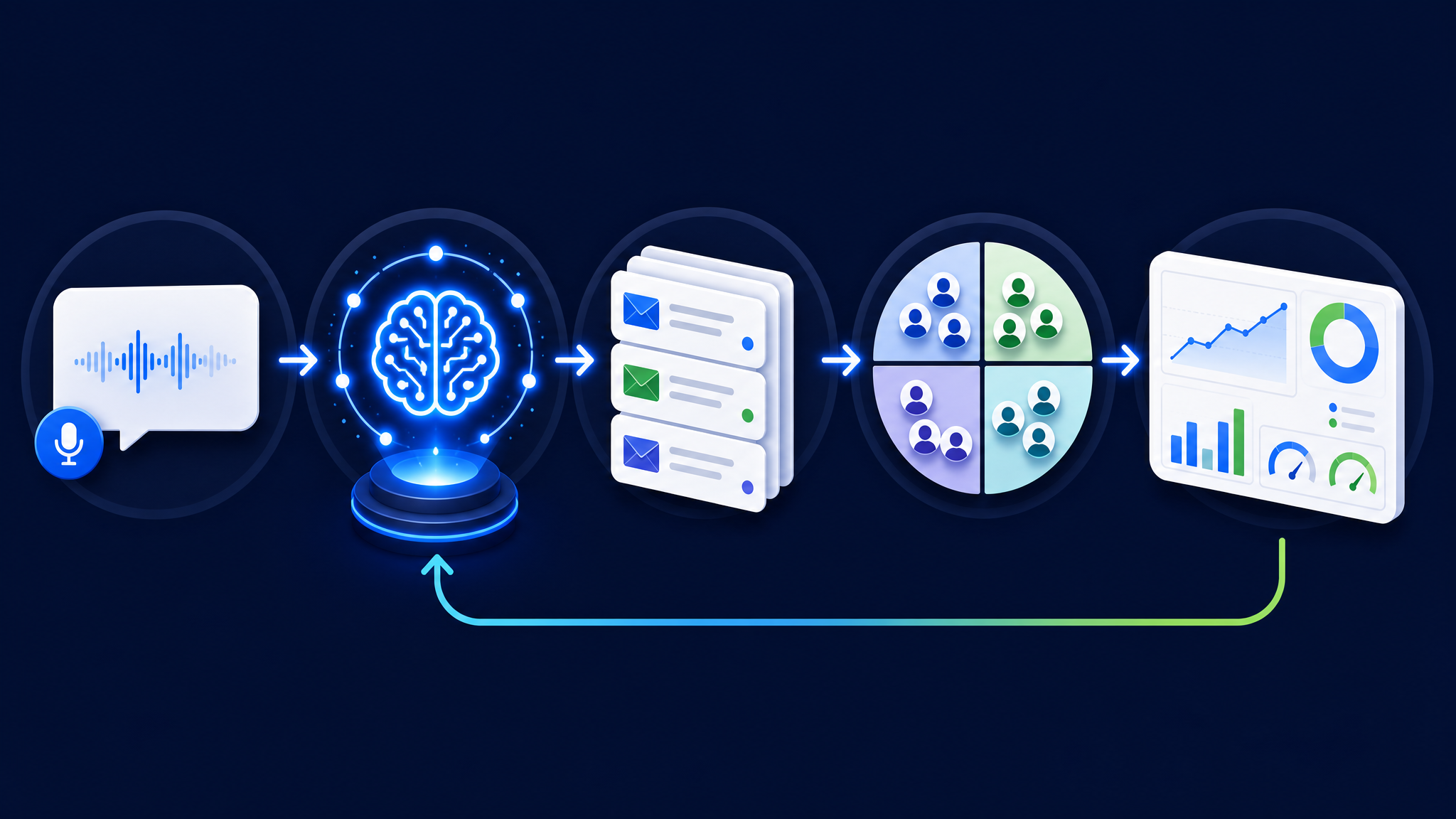
From a brief like that, your Keldio-connected AI agent can:
- Plan the campaign. Decide structure, message arc, sequence length, optimal cadence, and what each email should accomplish.
- Draft every email. Subject lines, preview text, body copy, calls-to-action — in your tone, refined and rewritten until it reads the way you want.
- Build the sequence inside the workflow builder. Steps, delays, conditional branches, exit conditions, follow-up logic.
- Attach the right media. Pull in images, product visuals, embeds; upload new assets if you give it a reference.
- Wire the hyperlinks. Buttons, anchor text, UTM-tagged tracking links, redirects to the right landing page or offer.
- Select the audience. Query your CRM, build the segment, exclude people who already booked or bought, respect consent flags.
- Set up tracking. Open rates, click-through, conversion events, server-side attribution, A/B variant assignment.
- Schedule the sends. Optimal time per recipient, frequency capping, send-window respect, time-zone awareness.
- Tie it into the rest of your system. A booked call stops the sequence; a purchase triggers an onboarding flow; a reply pauses automation and pings your inbox.
- Review what worked. Read open and click data after the campaign runs, surface what converted, draft a revision or follow-up campaign from what the numbers show.
You review. You approve. You adjust if something's off. But the production work — the part that normally eats hours per campaign — is no longer yours to do.
Why this hasn't been possible before
There are two halves of the same problem, and no system has solved both at once until now.
On one side, traditional marketing automation platforms have the operational reach. They can send emails, manage contacts, build sequences, run workflows. But they were designed before AI agents existed — built for a human to sit at the controls and click through builders, drag blocks, configure conditions, copy-paste copy, and pick lists from dropdowns. Some have added AI features over the years. Almost none of them connect to agents at the protocol level. Very few expose an MCP server at all, and the ones that do offer a thin surface — maybe contact lookup, maybe a send action — nothing close to the operational reach genuine agentic work requires. The result is that the human stays in the middle. The AI suggests. The human implements. The bottleneck doesn't move.
On the other side, generic AI writing tools have the intelligence. They can draft, refine, rephrase, summarise. But they sit beside your business, not inside it. Their output drops into a document and stops there. They can't schedule, can't pick the audience, can't wire a workflow, can't see your CRM. The human goes back to the controls and copy-pastes their suggestions into the platform.
Keldio is the first platform built explicitly for the agentic model. Every meaningful action — drafting, building, segmenting, scheduling, tracking, branching, tying into the rest of your stack, reading the results — is exposed as something an agent can actually do, not just describe. Bring your agent of choice — OpenClaw, Hermes, Claude Code, Codex, or any other agentic AI system — connect it to your Keldio workspace, and the human is no longer the executor. The human is the source of intent.
That's the unlock. AI writing is a feature. AI execution is the platform.
What this means for you
You go back to doing the only job that requires you specifically — having ideas. The follow-up sequence you'd been meaning to build for three months gets shipped in an afternoon, while you're talking to your agent on a walk. The campaign you sketched on a napkin actually goes live. The reactivation email for old leads stops being a tab you keep open and starts being a sent campaign with results.
You bring the intent. Your Keldio-connected AI agent ships the execution. Email marketing becomes a thing you do in the time it takes to describe what you want.